

Watch television shows online from home. All you need is our IP TV software, your computer, and online connection.
Online TV is the newest technology afforded to us by the amazing discovery of the Internet. Ever wonder what TV channels are like in France, or England or India? It's easy to find out, just turn on your computer and access your our IP television software account online. It's that simple. Could you have imagined even 20 years ago that you would be able to tune in and watch a TV show from another part of the world?
live television is simply being able to watch a broadcast in real time from anywhere around the world. Many of us discovered live Internet television during this past presidential campaign when we were, as a nation, practically glued to some form of media in order to keep updated on the progress of the election. Some of us were acquainted to live Internet television because we found it was an excellent way not only to keep updated with the news, but also weather, sport events.
There are other web portals that are created specifically to Online TV. Pages like our IP television software give you the option of watching anything you like. You can either search or look at the different genders of
Showing posts with label bali culture. Show all posts
Showing posts with label bali culture. Show all posts
Thursday, May 6, 2010
This Day We Celebrate Pesugihan Day

Sunday, April 11, 2010
My New Knowledge From Balinese Culture

 ceremonial and passing our home, my grand father brother can bring to "Bale Sari"
 as a dead person. And people had told about this news.
Thursday, March 18, 2010
Kissing Ceremonial at Sesetan

Wednesday, March 10, 2010
What we can do to safe Balinese?
I am a Balinese but almost whole of my live is in out of Bali, after graduate from medical school in Jakarta I decided to work in Bali. I was about three years ago, the first time I know about Bali, the beauty makes I can’t leave Bali, the culture and society its comfort me, and Bali is the place where I found my first girl for my live.
I found Bali that’s full by foreigners; it is not just from another country but also from another islands in Indonesia. World are known Bali is a safe place that you can go around safely, but we also hear about a tourist losing their wallet in daylight because of motorcycle thieves, Japanese tourist being killed and rape on the street, villa robbery, etc. Now is very rare, tourist still safe going anywhere by them self safely, but if this community problem more often happen will be damage Bali tourism.
Foreigners are not also having their vacation in Bali. Most of businesses in Bali are running by foreigner. Very rare Balinese have there own business, they only being employees or worker. Balinese competitive levels are very low compare by foreigner, although there are also great successes Balinese. Many reason of it such as, community tough that do not need to take high degree, if you a male have a lot of land that’s enough just stay home, Balinese have a lot ceremony so will have lots of off days and many more. Balinese will be marginalize like Betawi people in Jakarta that being drive away from their land. Many Balinese are losing their land for build villa. In long run Balinese community will be destroyed and leaving to another island in Indonesia.
Sallow thought most of Balinese very damaged Balinese competitive level. Society said it is like a turtle. A turtle will pull down its friend above when climbing a rock, and pushing downs its friend below. So who will be on top? Jealousy is Balinese bad character.
There is many Balinese if they have their success, they will be arrogant and tread their worker. It is very bad, human resource is the most of company they have to realize it. This condition makes a bad competitive level of Balinese company compare from Foreigner Company.
Balinese must changes this character for increase their competitive level, they have to be a great educated, and have a wide knowledge. We must change Bali, we cannot blame foreigner for what happen now.
I am a doctor, I meet many people and as society “Guru” I always share this though to the society to safe Bali.
Dr. Agung
Monday, February 22, 2010
A Village with a Pure Balinese Unique Culture

Thursday, February 18, 2010
Tajen Most Favorite Attraction in Bali

Gambling is illegal in Indonesia. But in many place usually in some Balinese ceremonial we can see a cockfight attraction. Cockfight attraction is a part or Balinese culture. Balinese are playing this game since prehistorically. This cockfight is given name “Tajen”. Because it cannot separate from Balinese religious ceremonial it cannot remove completely from tradition. Read more
Wednesday, February 10, 2010
Megibung

Monday, February 8, 2010
Paternalistic Sometime Makes Problem | Socyberty

Paternalistic is a system of Balinese social life and religion, they believe their sons is reincarnation from them ancestors. But sometime because of this system they too spoiling their son. So sometimes its make their son un-respecting them parents.
click below for reading my full article:
Paternalistic Sometime Makes Problem | Socyberty
Posted using ShareThis
Sunday, January 31, 2010
Mekepung Pure Excitement in West Bali

Negara, Jembrana district is not a particularly touristy region. However, you need to be there nice and early on Sunday morning, reday for action of buffalo races. "Mekepung" is the name given to these incredible buffalo races. They are take place every Sunday morning and are popular gatherings for the locals. Races start around 7 o'clock and continue until mid-day. It's crowded, noisy, and everyone from the province Jembrana totally absorbed by the races, often betting money. Go to the public races, held about 5 km of North West of Negara town.
Wednesday, November 4, 2009
Ketut Liyer Balinese Ancient Medicine man

In Eat Pray Love, Elizabeth Gilbert talks extensively about a Balinese medicine man, Ketut Liyer, with whom she spends a lot of time. Ketut Liyer is a traditional medicine man, Balinese called "Balian", he is the ninth generation of "Balian". There are two kind of "Balian" the white and the black one. The white Balian usually also is Hindu's holy-man. Both of them are using a sidekick power. But there also a different kind "Balian" whom didn't use a sidekick power, only learning from "lontar", a Balinese ancient scripts. Usually there are using massage technique, or medication from the nature, exp leaves.
Wednesday, October 28, 2009
The Kecak dance


The Kecak dance is one of the most famous of Balinese dances, known also as the "Monkey Dance," in which the men of an entire village take part. Originated in the 1930s and is performed primarily by men. It is unusual because it has no musical accompaniment like many other Indonesian dances do, the rhythm of the dance is produced by the chanting 'monkey' chorus. Instead, a troupe of over 150 bare-chested men serve as the chorus, making a wondrous cacophony of synchronized "chak-achak-achak" clicking sounds while swaying their bodies and waving their hands .From that chanting noise of "Cak-cak-cak", then it gave the dance its name Kecak. Hanoman Obong is a chapter from the most famous traditional bali dance "Kecak".
There are two place in Bali have good place performance of Kecak Dance:
1. Tanah Lot
The Kecak Perfomace dance beside the beach and the temple while there is Sunset, see the place here: http://baliflash.blogspot.com/2009/08/tanah-lot-temple.html
2. Uluwatu
at the Uluwatu Temple, the dance performance is beside the clift, a great combination between great dance performance and great clift views, see the place here: http://baliflash.blogspot.com/2009/08/pura-luhur-uluwatu-uluwatu-temple.html
Saturday, October 24, 2009
Praying At Tanah Lot Temple


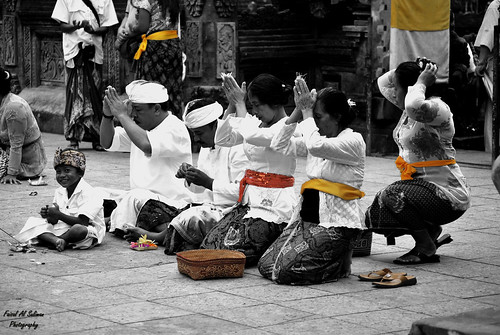
This day are Kuningan Day, every Balinese came home and praying at them family praying place at their home, we call the place "Merajan". Many different culture activities we have to celebrate this Kuningan Day, at my village usualy after praying we doing "Mesuryak", we are trowing small change into childrens that have waiting to grap those changes money.
After praying at our Merajan, some of us were going to Tanah Lot. Before we are praying at Tanah Lot Temple, first we pray at Pura Griya Ageng Luhur Pakendungan, second we are praying at Pura Kahyangan Luhur Pakendungan, after that we are praying at Tanah Lot.
Happy Kuningan's Day to all Balinese
Thursday, October 22, 2009
Penjor It's one of Balinese great art culture

Every Galungan an Kuningan day and at Odalan Ceremonies, Balineses makes them great art and very originally "Penjor". usually it's putting in fron them houses and Pura, and also at front of streets enter/ "Gapura". We can found it also in many place like Hotels, Villas, Restaurants, or at wedding ceremony places for welcome the Guess.
A penjor is basically a long tapered bamboo pole that is stood vertically in the ground, often on the roadside, and decorated in coconut leaves. Due to their length of sometimes more than ten metres, they droop charmingly over the pavement like an ancient street lamp.
At Galungan time, Balinese Hindus erect a penjor in front of their houses to symbolise the dominance of good (dharma) over evil (adharma), as well as offering thanks to God for the fruits of the Earth. About halfway down the pole they attach a small cage in the shape of a triangle and made from bamboo, called sanggah cucuk. Offerings are placed in this and it is considered to be a temporary “throne” for the Gods when they come down to Earth for Galungan. If you take a close look at a Galungan penjor, you’ll notice that it’s also ornamented with coconut leaves called sampian and also long strips of white and yellow material to symbolise that it is a holy offering.
There many kind of Penjor depend the place culture, different place different Penjor, it is are Balinese community creativity, so thats makes the different.
The cost of making Penjor also in variation, many claim it about hundreds rupiahs, but some claim their penjor cost millions rupiahs.
Wednesday, October 21, 2009
Kuningan Ceremony


On 24 october 2009 Balinese will celebrate Kuningan day. Kuningan takes its name from the fact that a special offering that is presented in this holyday is yellow rice (nasi kuning) is made by colouring ordinary white rice with tumeric (kunyit). Kuningan occurs once in every 210 days in the Balinese Pawukon cycle (traditional Balinese calendar). The Kuningan Day is the time for commemoration as the ancestors return to the heaven after ten days dwelling on earth and the Balinese express their gratitude to gods for His mercy to the human races.
Kuningan is a special day for ancestor worship since it is the last day of ancestor visit to the earth. On this day the deified ancestor will be suitably entertained and welcomed, and prayers and offerings must be made for them. Those families who have uncremated deceased ones buried in the village cemetery must make offerings at the graves. The Kuningan ceremony must be held before noon, since Balinese believes that the ancestors will ascent back to their respective abode at noon. The ceremony will be held in every Balinese’s family temple (sanggah or merajan). A special offering (Banten Kuningan) is made as a sign of respect to the ancestors. The offering consists of yellow rice (nasi kuning), for Balinese yellow is the symbol of greatness and magnificence. Tamiang (a decorative young coconut leaf arrangement resembles a shield), tar (a decorative young coconut leaf arrangement resembles a weapon) and endongan leaf are obligatory decorations of Kuningan. They are hanged below the roof of shrines and houses. They represent the sense of security and awareness of Balinese in facing the life after Galungan period is over.
Kuningan is a private family holyday the ceremony is within the house compound in the shrines of the family temple (sanggah or merajan). Only those who have family ties will attend the ceremony, unlike the cremations or more public processions of village temple ceremonies.
Sunday, October 11, 2009


Monday, August 17, 2009
Tanah Lot Temple

In the story of Dang Hyang Nirartha(a Hindu high priest), when he traveled around Bali, he came upon tanah lot which is located in tabanan and here, he decided to stay the night. It is said that this very important priest came to bali in about 1411 according to the balinese icaka calendar, or 1489 AD by the western calendar.
After pending some time in the temple of Siva's Hair, he moved on going further east. The esteemed priest and his devoted followers followed the southern coastline of Ball on their journey. For the entire trip along the shores of Bali, 
The recordings were made in verse form. This priest was such a great man, that when he was totally involved in something. he forgot about all else and never tired in his journey. His feet virtually floated above the ground he traversed. It wasn't long before he arrived at a small Island almost, Joined to the shore that was made of coral. Here he stopped a moment to rest. The people here were all fishermen and they gathered together to pay their respects. The fishermen wanted Dang Hyang Nirartha to stay at their modest homes, but he refused their invitation. He wanted to spend the night on the small island because the air was cool and fresh. He also had a wonderful view from this vantage point.
That evening before he retired for the night, he was able to teach the people who came to see him moral ethics, religion and welfare. Dang Hyang Nirartha advised the
When Dang Hyang Nirartha finally left this place, the people with whom he had spoken, indeed built the holy temple and gave it the name "Pura Pakendungan" which nowadays is better known as "Tanahlot". This temple is well know throughout not only Indonesia, but the entire world. Why is this temple one of the favorite tourist attractions for people from around the world ? You should go and see for yourself - it is beautiful and unique. You will have to arrange to travel 31 Km from Denpasar and that will take about an hour. Ran port is no problem as tourist buses go there all the time if you won't have some other private transport arrangement.
The best time to see it is in the afternoon when the sun setting in he west splits the shore line in half along a north-south axis. His spectacle will live on long in your memory. There is a religious ceremony coming up on the 7th of August 1996. The atmosphere will be even further enhanced as the Balinese Hindus in their ceremonial rests go to the temple to pray.
Subscribe to:
Posts (Atom)
Follow me with facebook

exchange banners

Copy this code to your website to display this banner!


 Posts
Posts

